GENESISTHE LIFE 3.0 PROJECT
Seed round · £500K SEIS/EIS · September 2026
Live in production · served by the platform it describes

Hire a company.
Not a tool.

GENESIS puts a team of AI specialists to work on a one-person business, every day, inside limits the owner sets. Every action is scored before it runs, signed after it runs, and can be undone. Nobody else in this market can prove what their AI did. We can.

  PRE-REVENUE · BILLING LIVE · RAISING £500K SEIS/EIS  ·  EVERY NUMBER IN THIS DECK IS READ LIVE FROM THE PLATFORM'S OWN RECORDS

02
02 The pitch, as we would say it in the room

Two minutes.
Then you decide.

Good morning. My name is Samuel Deangelo. I run four businesses, and for years I did every job in them: the marketing, the sales, the books, the admin, the content.

So I built the team I could never afford. A set of AI specialists that plan the week, do the work, and stop to ask when it matters. Israel Olumide Isiavwe, my co-founder and COO, comes from the financial sector and has run one of those businesses alongside me; he owns the commercial side, compliance and this raise.

It is live. It bills. Our own companies run on it today. And it does one thing nobody else in this market does: it signs a record of everything the team did, so a customer, an auditor or an insurer can check it without trusting us.

We are asking for £500,000 under SEIS and EIS. It buys eighteen months and the distribution the product needs to win its first 400 paying customers.

Here is what it does, what it costs to win a customer, and what could go wrong.

03
03 The problem

Six jobs.
One pair of hands.

There are 32 million businesses in the UK and the US with no employees at all. Every one of them is run by someone doing six jobs, most of them badly, because they cannot afford the person who would do them well.

IHelp costs more than the business makes

A decent marketer, salesperson or bookkeeper is £6,000 to £9,000 a month. The owner earns less than that. So the jobs get done at midnight, or not at all.

IIThe AI on offer cannot be let off the lead

Today's AI tools will act in your name with no limits, no record and no way back. It is your brand, your card and your legal liability. So you end up babysitting the thing that was meant to give you your evenings back.

IIINobody can show their working

Ask any AI platform to prove what its agents did last Tuesday. Silence. Fine for a hobby. A deal-breaker the moment real money, real customers or a regulator is involved.

04
04 The product

Describe the business.
A working team shows up.

I · SAY WHAT'S ALLOWED

Set the limits once

How much it may spend, what it must never touch, how much freedom it gets. Cautious, Balanced or Autopilot. You can change it any morning.

II · THE TEAM WORKS

Specialists, not a chatbot

One plans the week. The others write, build and run the website, research leads, draft the emails you approve, chase the invoices, post to your channels and cost your ads.

III · READ THE MORNING NOTE

Two minutes over coffee

What the team did, what came in, what needs you. Approve with one click. Anything they did can be undone for 24 to 48 hours.
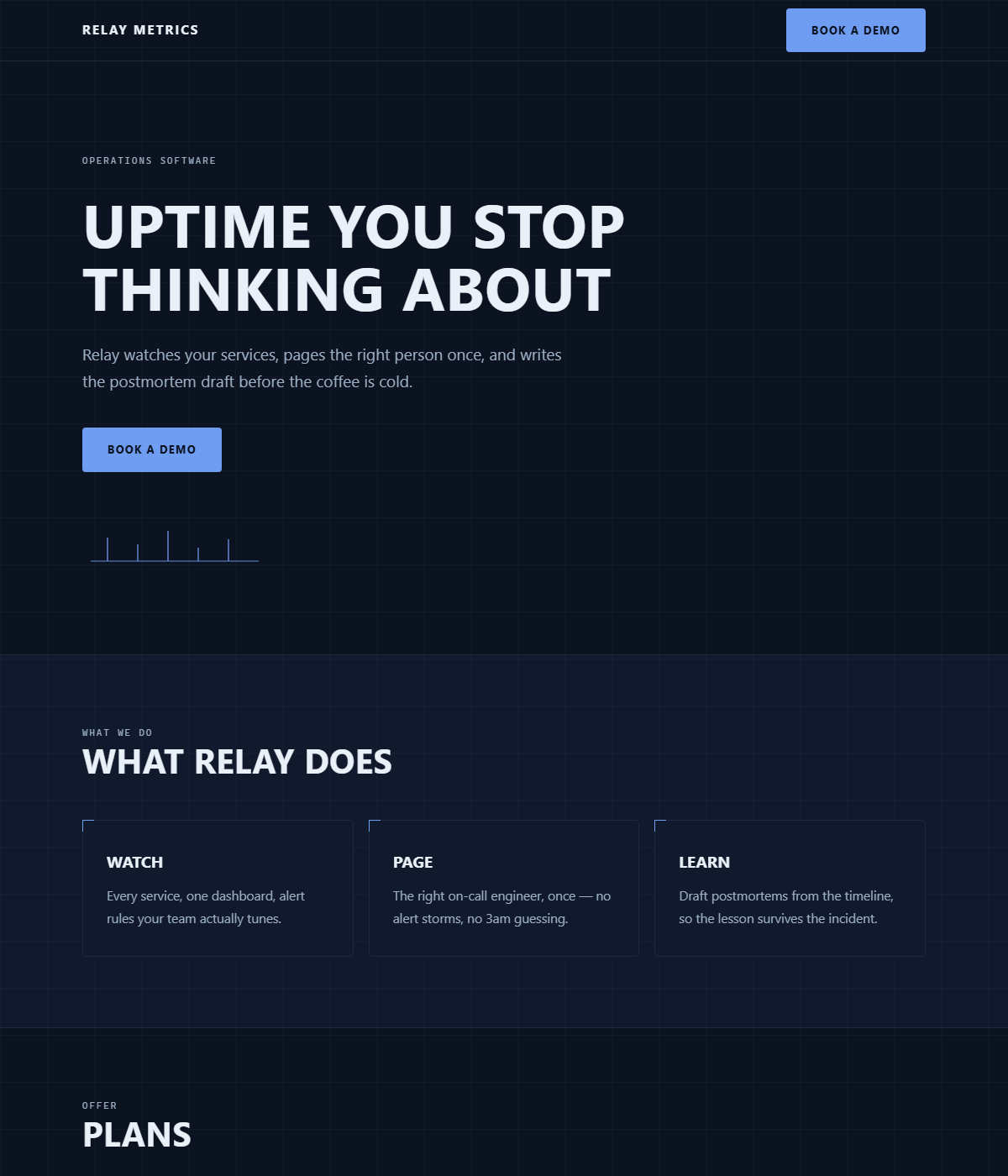
Website built by the platform for a software company
Built by the platform, no human edits: a software company, “Relay Metrics”
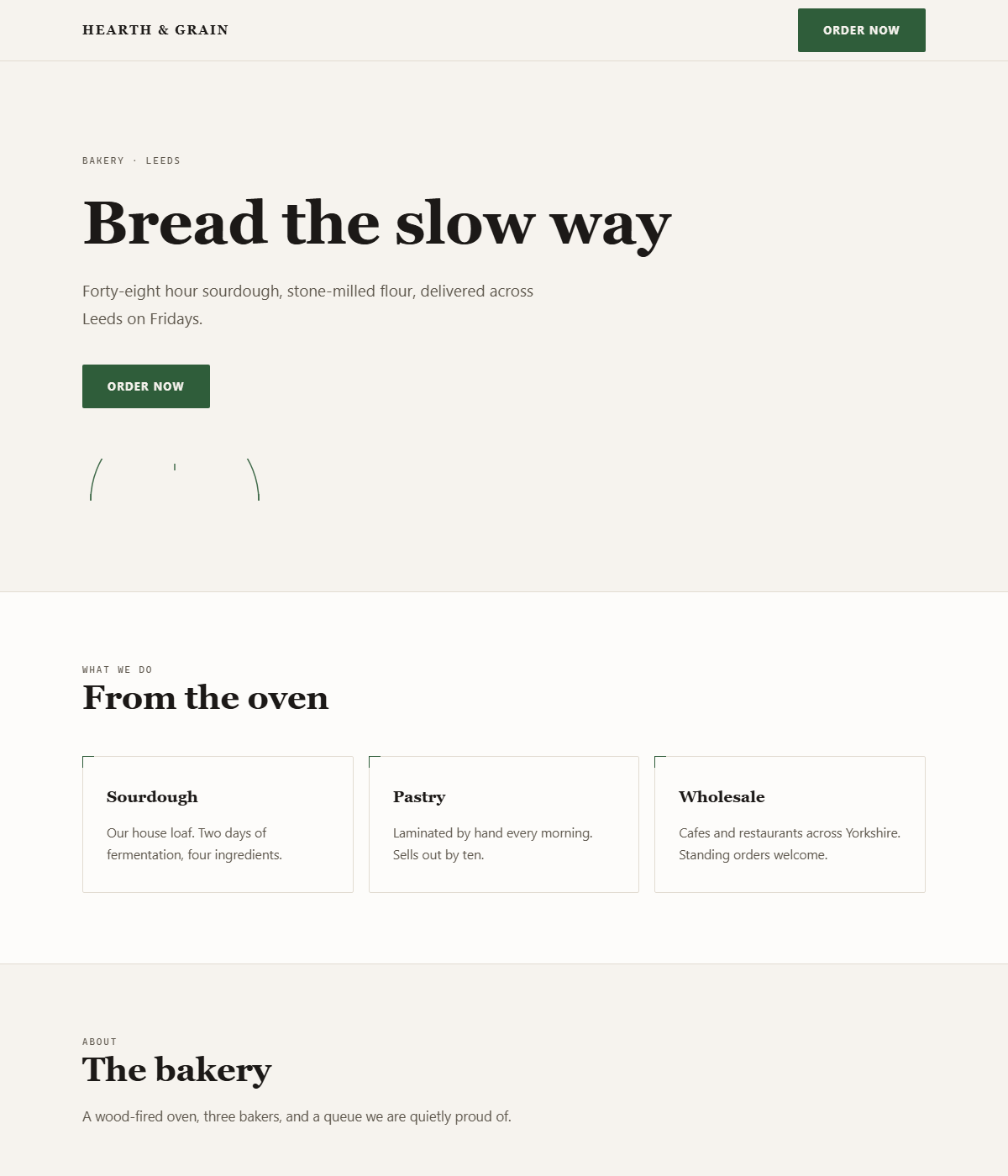
Website built by the platform for a bakery
Built by the platform one shift later: a bakery, “Hearth & Grain”
05
05 How it decides

It knows
when to ask.

Every action gets a score from 0 to 100 before it runs. Is it technically sound? Is it worth the money? Is it appropriate? Could it embarrass the owner? The score decides whether it goes, goes and tells you, or waits for you.

Under 40Held. Waits for a human. 40 to 69Runs, and tells you. 70 to 94Runs, and is logged. 95+Runs.
Always waits · ISpending or moving money.
Always waits · IIThe first message to someone new.
Always waits · IIIAnything regulated.

ON THE FREE PLAN EVERY ACTION WAITS. ON AUTOPILOT EVERYTHING INSIDE THE LIMITS RUNS. THE THREE ABOVE WAIT ON EVERY PLAN, HOWEVER SURE THE TEAM IS.

06
06 The edge

Anyone can say their AI behaved.
We can prove ours did.

Every action is written to a record that cannot be altered afterwards. Once a day an independent timestamp authority stamps that record. Even we could not quietly rewrite last week. A customer hands the signed export to a client, an auditor or an insurer, who checks it on their own machine against a key we publish. We are not in that conversation. That is the point.

RECORD   days anchored: 14  ·  stamped by an outside authority: 13 days  ·  ledger entries, current stamp window: 10,133  ·  signature: Ed25519  ·  timestamp: RFC 3161  ·  verifier: genesishq.net/static/verify_pack.py  ■ VERIFIABLE OFFLINE

Why customers stay

Two years of signed history does not move to a competitor who never kept one. Leaving means starting the record again from nothing.

Why not the model companies

They can build agents. They cannot be the independent record of what their own agents did. An auditor cannot audit itself. We sit on the buyer's side and use whichever model is best that year.

Why it compounds

Proof of good behaviour is becoming a purchasing question, from insurers to the EU AI Act. Our customers' evidence has been building since the day they signed up.

07
07 Where we are, honestly

Pre-revenue.
Here are the numbers
before you ask for them.

0Paying external customers
14My companies + test accounts on it
6,902Agent actions scored, all time
13Days stamped by an outside authority

Those companies are ours and our test accounts. This is not evidence of demand; demand is what the raise pays for. What it does show is a platform that runs unattended and behaves when something goes wrong. In August the model account ran out of credit for seven days. It published nothing half-finished, emailed us every day, and the record stayed intact throughout.

08
08 Why now

Cleverness is getting cheap.
Trust isn't.

Models became a utility

Each quarter the best models get cheaper and closer to one another. A company built on raw capability alone stopped being defensible some time in 2025.

The plumbing arrived

Agents can now find each other and pay each other. Finding one will be easy. Knowing which one to trust with money will not.

Proof became a purchasing question

The EU AI Act and ISO 42001 are turning "show me your governance" into something procurement asks for. We answer it with a signed record, not a policy document.

09
09 How we make money

Subscriptions pay the bills.
Value-Share is the upside.

Explorer
£0
One company. Every action waits for you. No card.
Operator
£49/MO
One company, routine work runs, the hands work.
Growth
£199/MO
Three companies, three seats, Autopilot.
Agency
£499/MO
Ten seats, for people who run businesses for clients.
Value-Share
£49+15%
Of what the business demonstrably earned. 10% above £10k a month. Never on ad spend. Every line verifiable.
How it is counted: every payment the customer's Stripe reports lands on their company's ledger with its Stripe event id; the share is worked out on those lines only and invoiced once a month through Stripe. Where a sale came through a link the team published, the ledger line carries the action it traces to. The customer can open the ledger at any time.

Three customers cover the infrastructure

Hosting and model costs are small. Salaries are the burn. Customers who run hot buy top-ups at £15 per thousand actions.

The margin is a line of code

Each customer's AI spend is capped at half of what they pay us. Worst case is a 50% gross margin. Measured on the live platform it is 82 to 88%. The model uses 70% to stay conservative.

The price is the truth

Every price on the pricing page is read from the same file the billing system charges from. Annual is twelve months for the price of ten.

10
10 The unit economics

£400 to win a customer.
Paid back in 5.2 months.

Month 0 · £400 spent Month 3 Month 5.2 · recovered Month 6

After that, every month is margin. At 3% monthly churn the average customer stays about 33 months, which is roughly six times what it cost to win them, at the conservative margin.

£110Revenue per customer / mo
70%Gross margin, modelled
8%Free to paid, assumed
3%Monthly churn, assumed

ASSUMPTIONS ARE LABELLED AS ASSUMPTIONS. MARGIN IS MEASURED. THE CAP ON AI SPEND IS CODE, NOT A SPREADSHEET.

11
11 The market

Big enough to matter.
Sized from the bottom up.

TAM · AI agents, 2030$53BN

From about $8bn in 2025, growing 41 to 46% a year. We are in the working-agents part of that, not the chatbots.

SAM · our buyer, per year£4.2BN

32 million businesses with no employees. Take only the 10% already paying for software: 3.2 million buyers at £1,320 a year, which is our own price ladder.

SOM · year-3 target£6.6M

Annual run-rate from 5,000 paying companies. That is 0.16% of the segment, from subscriptions alone, before the share.

SOURCES: MARKETSANDMARKETS (AUG 2026) · BCC RESEARCH · TBRC · UK DBT BUSINESS POPULATION ESTIMATES · US CENSUS NONEMPLOYER STATISTICS

12
12 Where the first customers come from

The product sells the product.
It is also the demo.

40%

Build in public

A company run by AI, narrating its own signed record every day, is content nobody else can make. An owned channel, so the cost per customer falls over time.

35%

Founder communities

Indie Hackers, UK accelerator alumni, agency and solo-founder networks. Referrals and partnerships rather than ads. Our own businesses are the case studies.

25%

Approved outbound

Our own outreach agent, every first message approved by a human and inside UK cold-email rules, aimed at the 4.1 million UK businesses with no staff.

£175K OF THE RAISE BUYS ROUGHLY 440 CUSTOMERS AT £400 EACH · THE MONTH-12 CHECKPOINT IS 400 PAYING COMPANIES

13
13 The field

The others sell an assistant.
We hand you a team, and the receipts.

AI helpers for small business

Polsia, Wix Symphony and others. They act, and they do not sign. Where a revenue share exists it lands on ad spend and the customer cannot check it.

Compliance platforms

Vanta, Drata, OneTrust. They audit companies. They do not run one, and they sell to enterprises, not to a founder with no staff.

Agent governance

Credo, Holistic. They police enterprise agents. They do not do the work.

GENESIS

Does the work. Keeps a signed record. Is paid on verified results. Sold to the one buyer the giants ignore: the person running a business alone.

WHAT THEY HAVE THAT WE DON'T: BRAND, MONEY AND DISTRIBUTION. THAT IS WHAT THIS ROUND BUYS.

14
14 Three years

The shape of it.
Argue with the assumptions.

Month 12Year 2Year 3
Paying companies4001,5005,000
Revenue per customer / month£110£110£110
Annual run-rate£0.53m£2.0m£6.6m
Gross margin, modelled conservatively~70%~70%~72%
People3714
Net burn / month~£28kcovered by revenuecash generative

The assumptions: £400 to win a customer, 8% of free users converting, 5.2 months to pay that back, 3% monthly churn. The margin floor is not an assumption; the code caps each customer's AI budget at half their subscription. Three customers cover the infrastructure. The £28k a month is people. The runway ends with four months in hand.

15
15 What could sink it

The four risks
we would ask about too.

Posting waits on platform keys

Email, invoice chasing, the owner's channel and a daily outreach cadence work today. Posting to X, Facebook and Instagram is built and goes live the moment the platform apps are keyed. LinkedIn waits on its API approval. Paperwork the money pays for, not new science.

It depends on someone else's models

August was the test. Credits ran out, and the platform held customer work rather than shipping rubbish. A second provider is wired in and models can be switched. Automatic top-ups are being switched on.

Key-person concentration on the technical side

I wrote the entire platform and I still ship it. Everything technical passes through one pair of hands. The mitigations: a written operating runbook, a second full-time founder who now covers commercial, compliance and the raise, and a platform that ran unattended for a week and behaved. A real risk, and I will not pretend otherwise.

Bigger names are in the market

Well-funded products sell AI help to small businesses and will keep improving. None signs the record, none is paid on verified results, none is built for a UK solo founder's compliance. That is the ground we hold, and it is narrower than it was in May. We say so.

16
16 The founders

Two founders.
One of us is the customer.

I run four businesses of my own: a trading education company I co-founded with Israel, a market-intelligence product, a regulated motor-finance introducer and an AI training academy. I wanted to hand parts of them to AI and could not, because nothing would show me what it had actually done with my name on it. So I built the thing that would, and put my own companies on it first.

Samuel Deangelo, founder & CEO

Product, engineering and the build-in-public channel. I wrote the platform and I ship it. My own businesses are its first customers and its testing ground.

Israel Olumide Isiavwe, co-founder & COO

Financial-sector background, full time on GENESIS. Owns commercial, compliance, finance and the raise. Co-founder of Pleuro Markets and its Market Breakers Course.

How two people run it

The platform runs and documents itself through its own agents, under our veto, with the signed record to prove it. One of us writes the code; the other runs the company around it. That is why two people can.

First hires

A growth lead is now the first hire, then an operations second-in-command, both within three months of closing. Both costed in the model.

Why this pairing: our wedge is agent behaviour that can be audited and verified. Israel has lived inside audit trails and regulated process; I have lived inside the code. We already run Pleuro Markets and its Market Breakers Course together. The record has to satisfy both of us before it satisfies anyone else.

17
17 The round
£500K SEIS first, then EIS
Eighteen months
Ordinary full-risk shares
No liquidation preference
Posting, outreach and product£200K
Marketing and growth£175K
Operations, second admin, security£75K
Legal, accounting, buffer£50K
M 2 to 3Platform apps keyed, so the built posting hands go live. First 100 free-plan sign-ups.
M 12400 paying companies, about £0.53m annual run-rate, the share collecting on verified records.
M 18A retention curve and a signed revenue history: the Series A pack, produced and signed by the platform itself.

Structure: £250k SEIS (the lifetime cap) issued first, then £250k EIS. Pre-money: £2.0m. £500k buys 20%; post-money £2.5m. Same share price across the SEIS and EIS tranches. Advance assurance: applied, awaiting HMRC.

DILIGENCE IS SELF-SERVED: EVERY NUMBER HERE CHECKS AGAINST /compliance/platform-metrics, SEALED AND VERIFIABLE OFFLINE · founder@genesishq.net

GENESIS · SEED DECK · BUILD 2974177 · SERVED 08 Sep 2026 18:05 UTC↓ ↑ TO MOVE · CTRL+P FOR PDF01 / 17